
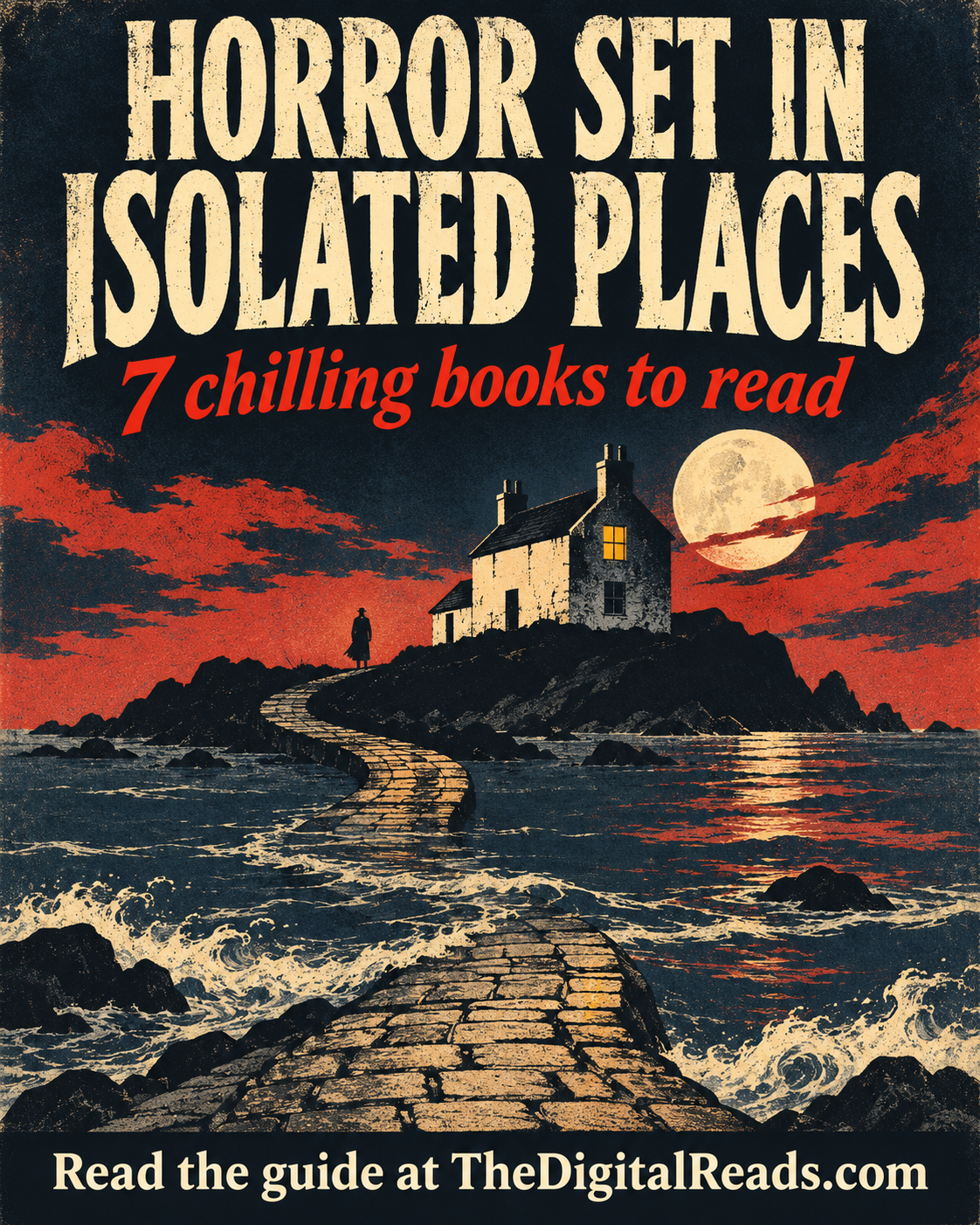
The tide is halfway across the causeway when you remember the upstairs window. It was shut when you left the house. From here, through a gap in the sea mist, you can see the curtain blowing out of it. There’s still time to go back and look. There might even be time to get off the island afterwards.
That’s the pleasure of horror set in isolated places. A good writer can make you argue with yourself about an upstairs window. The landscape gives you enough information to weigh the danger, then leaves one crucial thing out.
If you’re looking for isolated-setting horror books, start with Michelle Paver’s Dark Matter for Arctic dread, Susan Hill’s The Woman in Black for an English coastal haunting, or Darcy Coates’s From Below for the particular terror of having several decks of a sunken ship between you and daylight. Each gives its characters a different answer to the question every horror reader eventually asks. Why don’t they just leave? Michelle Paver
Arctic horror and the last chance to go home
In Michelle Paver’s Dark Matter, Jack Miller takes a job as a wireless operator on a 1937 Arctic expedition. It’s easy to understand why he goes. He’s lonely in London, short of money and hungry for the sort of opportunity his better-off companions can take for granted. When the expedition reaches the remote bay of Gruhuken, the reader has good reason to want him to stay. That early sympathy makes the approaching winter much harder to bear. Read Michelle Paver’s introduction to Dark Matter. Michelle Paver
isolated-horror-0.png
Paver gives the story a deadline you can picture. The light is going. The sea will freeze. Jack’s companions leave one by one, and a decision he could once have reversed begins to look permanent. There’s a lovely cruelty in making him a wireless operator. His whole purpose is to keep people in touch, yet a voice reaching him across the water would still leave him alone with whatever he thought he saw. Michelle Paver
Choose Dark Matter if the part of a ghost story you enjoy most is the embarrassed pause before someone admits they’re frightened. For a mountain setting, Paver’s Thin Air follows a 1935 expedition up Kangchenjunga. A climber who turns back has to reckon with the ambitions of everyone still going up. That makes retreat a much more interesting prospect than simply finding the way down. Explore the mountain ghost story Thin Air. Michelle Paver
Coastal horror and the road that disappears
One of the eeriest things about Eel Marsh House in Susan Hill’s The Woman in Black is that somebody has to go there on business. Arthur Kipps is a junior solicitor attending to the affairs of the late Mrs Drablow. Paperwork is waiting. There’s a house to visit. The causeway looks like a perfectly reasonable piece of English road, provided you arrive at the right time. Explore Susan Hill’s The Woman in Black. London Review Bookshop
isolated-horror-1.png
A tidal setting lets a writer do something particularly unsettling. The reader can imagine safety continuing quite happily within sight. Across the water, somebody is laying a table or putting another lump of coal on the fire. The people over there could tell Arthur more than they choose to. Their reluctance to discuss the woman he glimpses at the funeral gives him a second kind of isolation long before the mist comes down. London Review Bookshop
Pick this one if you love traditional English ghost stories, especially those in which a sound carries further than a person can see. It’s also a good book-club choice. Ask everyone to mark the first moment they would have gone home. The interesting part is hearing what each reader would have been prepared to say to their employer the following morning.
Snowbound hotel horror and the trouble with company
Stephen King found an idea for The Shining when he and his wife stayed at Colorado’s Stanley Hotel just before it closed for the winter. They were the only guests. King’s account of wandering its corridors helps explain a detail that can get lost behind the novel’s reputation. A hotel already looks faintly peculiar once the people it was built for have gone. Reception desks, dining rooms and rows of numbered doors all imply that somebody ought to be there. Read Stephen King’s account of the inspiration for The Shining. The Shining
Jack Torrance accepts the winter caretaker’s job at the Overlook and brings his wife Wendy and their young son Danny. For Jack, the job offers time to write and a chance to rebuild his life. For Danny, it means depending on adults whose understanding of the hotel falls well short of his own. The family share an address and experience three very different winters. The Shining
That makes The Shining a good answer for anyone who finds solitude rather appealing. Perhaps you’d enjoy a week snowed in with a stack of books. Would you enjoy having to persuade the only other adult in the building that something was wrong with your child? Company can make isolation worse when that one person’s judgement is all you have.
Wilderness horror and the friend who chose the shortcut
In Adam Nevill’s The Ritual, four old university friends take a hiking trip in the Scandinavian wilderness. The shortcut they choose carries them into ancient forest, where exhaustion, hunger and an alarming discovery put their friendships under pressure. Readers who like folk horror and creature horror will find both in those woods. Read the publisher’s introduction to The Ritual. Pan Macmillan
Forests play a different trick from islands. On an island you can often see exactly where you want to go. In dense woodland, you may be free to walk in any direction and have no idea which choice improves your chances. The person who most confidently remembers a landmark can become the most dangerous member of the party while sincerely trying to help.
If the most frightening part for you is the possibility that something has been studying the group, try The Constrictor Protocol. The Digital Reads introduces its engineered predator through a small, intelligent action. An animal presses its head against a support column to see whether it will give. Once you understand what the animal is doing, every wall around it looks a little thinner. thedigitalreads.com
Deep-sea horror and the distance to the surface
Darcy Coates’s From Below sends a team to film a shipwreck found hundreds of miles from its intended course. The attraction is obvious even if you’d never volunteer for the dive. Somewhere inside that wreck is evidence that could explain a disappearance people have wondered about for decades. For every good reason to turn around, there’s a door worth opening just a little further on. Discover Darcy Coates’s From Below. Darcy Coates
Underwater horror changes how you read the layout of a room. You start remembering which opening the divers came through. You notice how much space there is to turn around. The first journey along a passage is exploration. In your head, you’re already making the return journey in poor visibility, trying to remember whether that doorway was on the left or the right.
For a maritime ghost story where the ship is still afloat, Alma Katsu’s The Deep draws on the Titanic and her sister ship Britannic. Read Coates if you want to explore the rooms after everyone has vanished. Read Katsu if you’d sooner stand among the passengers and be one of the first to suspect that something is travelling with them. Darcy Coates
Space horror and the people who should be here
An empty kitchen can be more disturbing than a ruined spaceship. A wreck offers an explanation at first glance. Two mugs on a table in a room where nobody answers leave an awkward gap between what you see and what you know. The more ordinary the objects, the easier it is to imagine the conversation that stopped.
isolated-horror-2.png
That’s the appeal of The Last Human on Europa. A colony has fallen silent, its crew are missing, and the expected signs of destruction are absent. The detail that sells the mystery is what hasn’t happened to the place. If the buildings were torn apart, you could begin guessing what did it. An apparently intact station encourages a far more uncomfortable question. What made everybody leave? thedigitalreads.com
The Digital Reads has several ways to follow that interest. For a crime puzzle in a remote settlement, try The Mars Colony Murders. For another science-fiction horror read, explore The Hushed Earth. If the survival decisions interest you most, The Last Aquifer takes that question somewhere painfully practical. Who gets access to water when a community’s survival depends on protecting what remains?
Frequently asked questions about isolation horror
What is isolation horror?
Isolation horror places a person or group somewhere that makes help, escape or reliable information difficult to obtain. A snowbound hotel, a remote cabin and a damaged spacecraft all fit. One way to recognise it is to imagine moving the same characters onto a busy high street. If most of their frightening decisions would vanish the moment they could walk into a shop and ask for help, isolation is doing much of the work.
Which isolated-setting horror book should I read first?
Choose The Woman in Black if you like a traditional haunting and want a clear route into the genre. Try Dark Matter if you’d enjoy spending time with one increasingly uneasy narrator. If you prefer characters with a concrete job to do and a physical space to investigate, start with From Below. London Review Bookshop
What’s the difference between isolation horror and a locked-room mystery?
A locked-room mystery invites you to explain an apparently impossible event. Isolation horror asks what it feels like to remain in the place where something frightening is happening. The two can overlap beautifully. An abandoned station can give the puzzle reader a missing crew to account for and the horror reader a compelling reason to dread finding them.
Can a horror story feel isolated when lots of people are present?
Yes. A full passenger ship can be an isolated setting because everyone aboard shares the same limited means of escape. Within that crowd, a character can become lonelier still if nobody believes what they witnessed. For a reading group, try asking which would feel worse in the book you’ve chosen — being the last person awake or finally waking someone who tells you to go back to sleep.
What would make you turn the page tonight — a light across the marsh, a voice on the wireless or a mug still waiting for its owner? Follow that detail into The Digital Reads Book Finder, explore the full ebook catalogue, or take a chance on something unfamiliar from the Free Reads collection.
Comments ()