
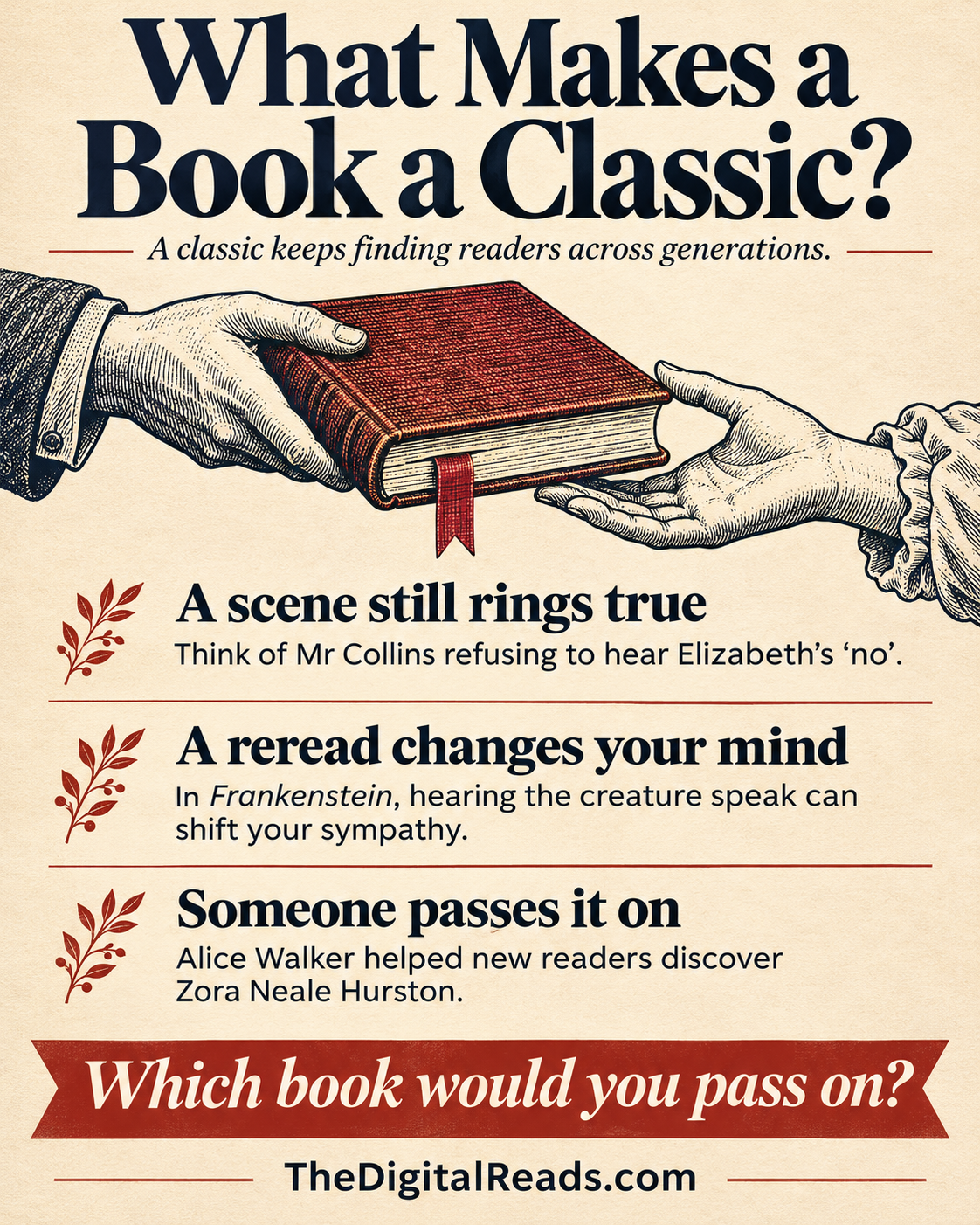
Mr Collins proposes marriage to Elizabeth Bennet. She says no. He takes this as an encouraging sign and carries on. More than two centuries after Jane Austen wrote the scene, you can still feel the agony of trying to end a conversation with someone who has decided what both of you mean.
That helps explain what makes a book a classic. A classic is a book that successive generations find worth reading, discussing and passing on. Its language might capture something unusually well. Its influence might change what later writers attempt. Sometimes it survives because a handful of people go to extraordinary lengths to put it back into readers’ hands.
How old does a book have to be to become a classic?
There’s no official birthday. Fifty years on a shelf tells you how long a copy has survived. It tells you very little about who has opened it. A better question is what happened after its first audience moved on. Did a teenager find it funny for reasons their grandmother recognised? Did a writer borrow its structure? Did someone argue so fiercely with its assumptions that they wrote another book in reply?
Even the word has shifted. In a Penguin discussion about classics and modern classics, Henry Eliot traces how a term once associated especially with Greek and Roman writing came to include Shakespeare, much later authors and eventually whole publishing lists. A publisher’s Modern Classics imprint tells you something about its editors’ judgement. Another publisher, a bookseller and your local reading group can each draw the boundary somewhere else.
Three clues that a story has staying power
1. A small scene still rings true
In Pride and Prejudice, Mr Collins can discount Elizabeth’s refusal because he believes a young woman is expected to refuse a proposal before accepting it. He even has an explanation ready for her insistence that she means what she says. Watch how little Elizabeth can do, within the rules of politeness, to make a perfectly clear sentence stick.
The scene is funny on a first reading. It becomes considerably less comfortable once you remember that Mr Collins is in line to inherit the Bennet home. Elizabeth can afford honesty in that moment only because she is willing to live with its consequences. When her friend Charlotte makes a different choice, you have to decide how far your sympathy stretches. Austen gets two very different marriages out of one dreadful proposal.
2. The book is stranger than the story you remember
Think of Frankenstein and you might picture the instant the creature opens his eyes. Mary Shelley also gives him time to speak. He watches a family from concealment, learns their language and hopes that a blind man might hear him fairly. By the time he asks his maker for a companion, you know something Victor would find it easier to ignore. His creation has spent a long time trying to understand other people.
That changes the question you take away. Would you trust Victor to tell you what the creature deserves? Would you trust the creature to tell the whole story either? Shelley gives both of them the chance to persuade you. Knowing the famous premise still leaves much of the experience waiting on the page.
3. Rereading shifts your loyalties
In his essay on why we read the classics, Italo Calvino considers what happens when we revisit a book after years away. Try it with a novel you remember particularly well. Before opening it, write down who you thought behaved worst. Then find the scene that made up your mind.
You might discover that the line you remembered as cruel was spoken by someone trying desperately to save face. Or the character you once dismissed as timid might be the only person in the room who understands the danger. Even if your judgement holds, you now have a sentence to point to when another reader challenges it. Our guide to disagreeing about a book without falling out is a good place to take that conversation next.
Who decides which books become classics?
Consider Zora Neale Hurston’s Their Eyes Were Watching God. Published in 1937, it lets Janie Crawford tell a friend about the life her neighbours have been so busy judging from their porches. Even before you know where Janie has been, you have heard the gap between the story a town tells about a woman and the one she wants to tell herself.
When Hurston died in 1960, her books were out of print. In 1975, Alice Walker published an essay that helped renew interest in her work. The writing on the page had stayed the same. What changed was the chance that a reader could walk into a bookshop and find it. You can follow that history in the National Endowment for the Arts reading guide and the US Copyright Office’s account of Hurston’s rediscovery.
This is where the literary canon comes in. The term describes a group of works that a community treats as especially important. A teacher can keep a book in circulation by teaching it. A translator can give it a readership in another language. A librarian can put a newly reissued novel into the hands of someone who came in asking for something else. Hurston’s story makes a good question to bring to any list of classics. Which books had someone in a position to do that for them?
How to choose a classic you’ll actually enjoy
Start with the sort of scene you already read past bedtime for. If you love an awkward conversation, try Austen. If you want two persuasive people giving incompatible accounts of the same disaster, try Shelley. If a voice can carry you through a whole book, read the porch scene at the beginning of Hurston’s novel and listen to how the rhythm changes when Janie talks to her friend.
Give yourself permission to begin on page one of the story. An introduction written for people returning to a classic may discuss the ending in its first paragraph. Save it as an afterword if you enjoy finding your own way. For a translated classic, try the same opening page in two editions. Read each aloud. The version whose next sentence you want to hear has already done something important.
What to read alongside a classic
Pair an older book with a contemporary one by choosing a question you want to keep thinking about. These three pairings make good starting points for a reading group.
After Frankenstein, ask who lives with the consequences of an invention. In The Weathermakers, a scientist acts where negotiations have stalled, raising the question of who pays for a decision about rain. The Fall Trilogy takes the dilemma in another direction when a solution to an energy crisis puts the Moon itself at risk. Which decisions would you have supported before you knew how things turned out?
After Austen, follow the distance between saying something and being understood. Try Letters to the Wrong Address for contemporary romance. Or take that interest into fantasy with The Clockwork Oracle, where Wren meets the emperor she is supposed to kill while he is winding a clock. Watch for the ordinary detail that makes you reconsider the person in front of her.
After Hurston, look closely at what a community notices. A spider building a web above a village post office gives neighbours something to stop and look at in The Vigil at the Edge of Everything. For a sharper argument about belonging, try The Last Aquifer. When a community controls a precious source of fresh water, who gets to decide where its obligations end?
Frequently asked questions about classic books
What is the difference between a bestseller and a classic?
A bestseller has sold strongly within a particular market or period. Calling a book a classic makes a judgement about what it continues to offer readers. A novel can earn both descriptions. A book that reached very few people on publication can also acquire a substantial readership decades later.
What does “instant classic” mean?
It’s a prediction. A reviewer is saying that a new book feels distinctive enough to last. A modern classic has usually had more opportunity to find a second audience. Neither phrase comes with a fixed age or a certificate.
Can horror, romance or children’s books be classics?
Yes. A genre gives readers a way to describe the experience a book offers. Calling something a classic describes its standing over time. Frankenstein is an easy place to see those ideas overlap. You can read it for the horror of what Victor makes and return years later for the conversation between maker and creature.
Do I have to finish a classic I dislike?
You can put it down. Before you do, try identifying the difficulty. If you keep losing track of the speakers, an audiobook might help. If you understand everyone perfectly and would cheerfully leave them all at the next station, pick another novel. Being able to say exactly where a celebrated book lost you makes for a better discussion than dutifully turning another hundred pages.
Think of one book you would press into somebody else’s hands. Which scene would you love to hear them talk about afterwards? That small act of passing a story on is something every classic depends on. If you’re looking for a new book to give that chance, browse the Free Reads shelf at The Digital Reads.
Comments ()